AI Search Visibility
How to Get Your Local Business Recommended by ChatGPT in 2026
By Angela Wauthier, Kermit Lowry & Jeff Donahue · hav0k Marketing · · 8 min read
Quick answer: To get your business recommended by ChatGPT, make your business facts identical everywhere, earn a steady stream of fresh Google reviews, keep your own website current and readable, rank in the Google Maps local pack, and get mentioned on trusted local sites. AI tools pick businesses they can verify. There is no paid shortcut.
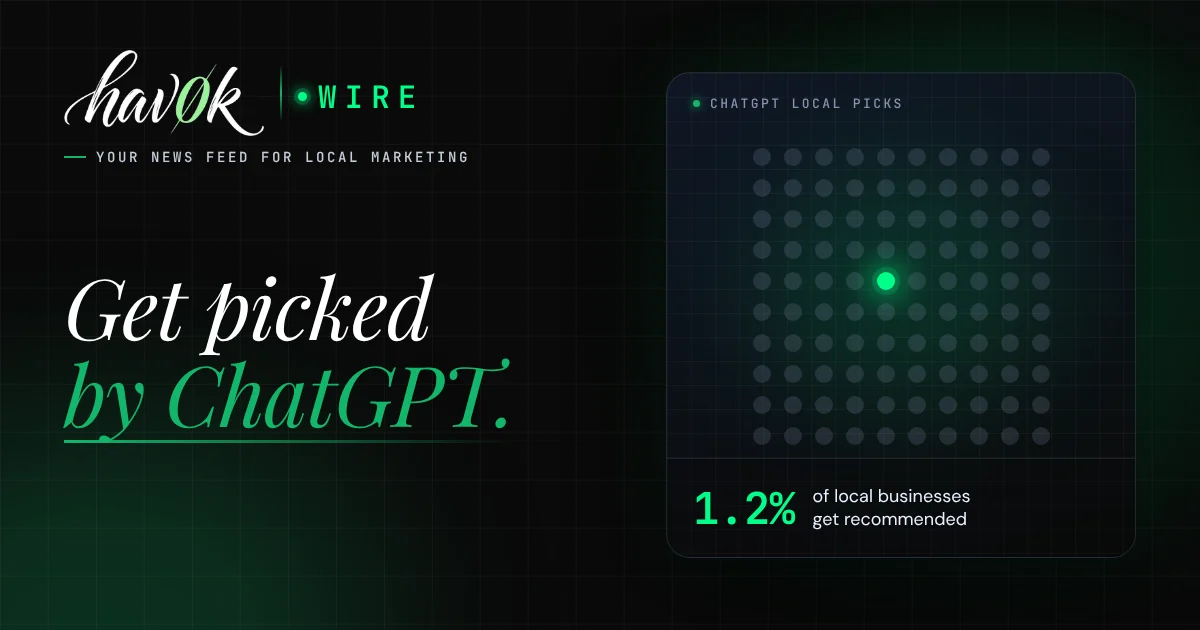
Your customers are already asking. In BrightLocal's 2026 survey, the share of consumers using AI tools for local business recommendations jumped from 6% to 45% in one year. The catch: in a study of more than 350,000 locations, ChatGPT recommended just 1.2% of them. This guide covers why most businesses get skipped and what actually moves the needle.
Why AI Recommendations Matter for Local Businesses Now
AI went from a novelty to a real discovery channel in about twelve months.
- 45% of consumers used AI tools for local business recommendations in 2026, up from 6% in 2025. That makes AI the third most used source, behind Google and Facebook and ahead of Yelp (BrightLocal).
- 64% of adults aged 30 to 44 have asked AI for a business recommendation in the past year, the heaviest users of any age group (BrightLocal AI trust report).
- Google's share is shrinking. Use of Google for local reviews fell from 83% to 71%, while Apple Maps nearly doubled from 14% to 27% (BrightLocal).
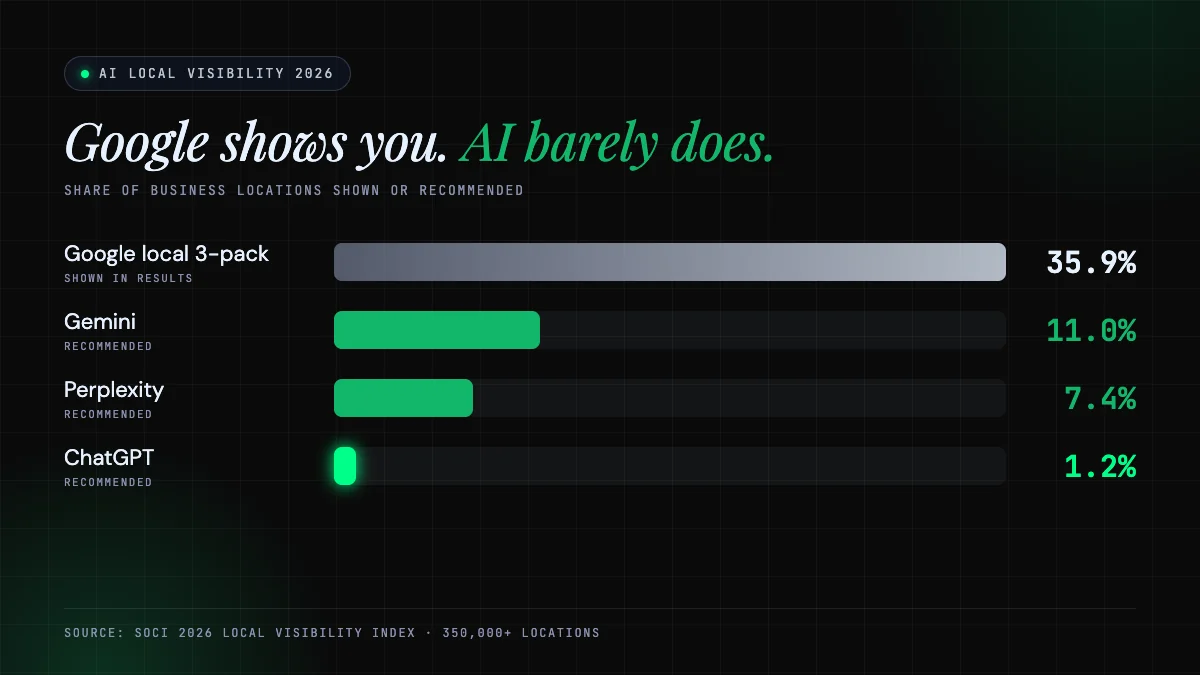
Here is the part most owners miss: AI is far pickier than Google. SOCi's 2026 Local Visibility Index found brand locations showed up in Google's local 3-pack 35.9% of the time, but ChatGPT recommended only 1.2% of them. Gemini recommended 11% and Perplexity 7.4% (SOCi via Search Engine Land).
So the opportunity is real, and the competition for those few spots is wide open.
How ChatGPT Chooses Which Local Businesses to Recommend
ChatGPT does not have its own business directory the way Google has Business Profiles. When someone asks for "the best vape shop near me," ChatGPT rewrites the question into search queries and sends them to partner search providers. It can also pull nearby business listings from third-party data providers (OpenAI Help Center).
That means ChatGPT is stitching an answer together from whatever it can find about you across the web. OpenAI is upfront that "there is no way to guarantee top placement."
Different AI tools read different sources
| Google Maps local pack | ChatGPT | Gemini | Perplexity | |
|---|---|---|---|---|
| Main data source | Google Business Profile | Web search partners + third-party listings | Google Maps data | Web search + listings |
| Share of locations shown or recommended (SOCi 2026) | 35.9% | 1.2% | 11.0% | 7.4% |
| Accuracy of business info (SOCi 2026) | N/A | 68.3% | 100% | 68.0% |
Sources: SOCi 2026 Local Visibility Index. SOCi's data covers multi-location brands, so treat it as a benchmark, not a guarantee for a single shop.
Two takeaways from that table. First, Gemini is grounded in Google Maps, which is why its business info was 100% accurate. Your Google Business Profile still matters a lot. Second, ChatGPT and Perplexity pull from scattered sources, so if your hours or address are wrong somewhere, there is a real chance the AI repeats the mistake or skips you. And the bar for reputation is high: locations ChatGPT recommended averaged 4.3 stars.
Ranking #1 on Google does not mean ChatGPT picks you
In an October 2026 test of 250 AI recommendations for local services, only 31% of ChatGPT's picks were businesses in Google's top 3 map results (Ryan Doser research). The four AI assistants tested agreed on the same first pick in only 6 of 72 comparisons. AI visibility is its own channel, and you have to check it separately.
7 Steps to Get Your Business Recommended by ChatGPT
These steps are based on what the largest 2026 studies found AI tools actually reward. None of them are tricks. They are the same fundamentals that win in Google Maps, done more consistently.
1. Make your business facts identical everywhere
AI tools cross-check your name, address, phone number, hours, and services across sources. When those don't match, they tend to leave you out.
Insites analyzed 10,000 local businesses and found 93% were known to at least one AI platform, but only 55% had accurate information. The rest were shown with wrong addresses, wrong hours, or mismatched services (Insites).
Check and match these at minimum:
- Google Business Profile
- Apple Business Connect (Apple Maps usage nearly doubled this year)
- Bing Places
- Yelp and Facebook
- Your own website, including the footer and contact page
2. Earn a steady stream of fresh Google reviews
Review volume had the strongest link to AI visibility in the Insites study. Businesses that both ChatGPT and Perplexity found averaged 133 Google reviews. Businesses invisible to AI averaged 11 (Insites).
Freshness counts too. 74% of consumers only care about reviews from the last three months (BrightLocal). Build asking into checkout: a text after purchase, a QR code at the register, a line on the receipt.
Two rules to protect your profile:
- Never offer discounts or freebies for reviews. Google removes incentivized reviews (Google Maps content policy).
- Ask everyone, not just happy customers. Selectively asking only for positive reviews also breaks Google's rules.
When customers mention a specific product, service, or your neighborhood in their review, AI gets more context about what you do and where. You can't script reviews, but you can ask a specific question like "What did you come in for today?"
3. Keep your own website current and readable
Your website is the source AI cites most. ChatGPT cited the business's own site in 72% of awareness and reputation queries in the Insites study, and in over half of recommendation queries. Businesses visible to AI had more than double the pages, and sites that hadn't been updated recently were less likely to show up.
This is where the technical side matters. Insites found AI reads a page's raw code and doesn't run JavaScript. If your site only shows your services and hours after scripts load, an AI crawler may see an empty page. Ask your web provider whether your key content appears in the page source.
Practical fixes:
- One page per core service or product category, written in plain language
- Your city and neighborhood named naturally on the page
- Hours, address, and phone in text (not only inside an image)
- Old promos, old hours, and outdated menus removed
4. Rank in the Google Maps local pack
Google and AI are not separate worlds. Businesses in the local pack were recommended by AI 3.5 times more often in the Insites study, and Gemini runs directly on Google Maps data. A complete, active Google Business Profile with accurate categories, photos, products, and regular posts is still the foundation.
This is also why we track Maps rankings weekly for hav0k clients with heatmap scans. Your rank can change from block to block, and you can't fix what you don't measure.
5. Get mentioned on trusted local sites
AI tools build confidence from more than one source. A business with a strong Google profile and nothing else is easier to skip than one that also shows up on Yelp, local news, chamber of commerce pages, and "best of" lists in its city. SOCi's research names Google Business Profile, Yelp, Facebook, and brand websites as the core sources AI tools draw from.
Good places to start:
- Local news "best of" roundups and community features
- Your chamber of commerce or business association directory
- Industry directories for your category
- Sponsorships and events that get you a listing on another local site
6. Don't waste money on AI gimmicks
Here is our honest take: a lot of "AI SEO" advice is hype. In the Insites study, page speed, Core Web Vitals, structured data, llms.txt files, and FAQ schema showed no meaningful correlation with AI visibility. Those findings are correlations, not proof, and good technical setup still helps Google understand your business. But no plugin or file will get you recommended on its own.
If someone is selling you a guaranteed ChatGPT ranking, walk away. OpenAI itself says no one can guarantee placement.
7. Check what AI says about you every month
Because each assistant answers differently, you need to look. Once a month, ask ChatGPT, Gemini, and Perplexity the questions your customers ask:
- "Best [your category] near [your city]"
- "Is [your business name] open on Sundays?"
- "What does [your business name] sell?"
Note whether you appear, whether your details are right, and who shows up instead. Don't trust the AI's numbers blindly either. In the Ryan Doser test, ChatGPT described one business as having 1.0 stars from 2 reviews when Google showed 4.3 stars from 84 reviews. Wrong data is exactly what step 1 fixes.
At hav0k, this check is built into our AI Visibility Report, which shows whether ChatGPT, Gemini, and others recommend your business and what they say.
What This Looks Like for a Real Shop
Our client Crush Vapor & Smoke Shop in Evansville, Indiana, is a good example of the fundamentals AI looks for. Two locations, a 4.6-star rating, more than 530 reviews, and the #1 Google Maps spot at the store for "vape shop near me." That is the profile of a business AI tools can verify: lots of fresh reviews, accurate listings, and strong local pack visibility.
Smoke and vape shops, liquor stores, and other high-risk categories often get extra scrutiny online. If that's your industry, see our smoke and vape shop marketing setup. For high-risk payment processing, our sister company Lifelong Merchant Services covers high-risk merchant accounts.
Frequently Asked Questions
How does ChatGPT decide which local businesses to recommend?
ChatGPT rewrites your question into web searches, sends them to partner search providers, and can pull nearby listings from third-party data providers. It then combines what it finds. Businesses with consistent information, strong review counts, and a clear website are easier for it to verify and recommend.
Can I pay to be recommended by ChatGPT?
No. OpenAI says there is no way to guarantee top placement in ChatGPT search. Be cautious of anyone selling guaranteed AI rankings. The reliable path is accurate listings, fresh reviews, a current website, and mentions on trusted local sites.
Does ranking #1 on Google Maps mean ChatGPT will recommend me?
Not always. In an October 2026 test, only 31% of ChatGPT's local picks were in Google's top 3 map results. A strong Google Maps ranking helps, since businesses in the local pack were recommended 3.5 times more often in one study, but you should check AI tools separately.
How many Google reviews do I need to show up in AI answers?
There is no official number. In a study of 10,000 local businesses, those visible to both ChatGPT and Perplexity averaged 133 Google reviews, while invisible businesses averaged 11. Steady, recent reviews matter more than a one-time push.
Do llms.txt files or schema markup help with ChatGPT?
Not on their own. A 2026 study of 10,000 businesses found no meaningful correlation between AI visibility and llms.txt, structured data, or FAQ schema. They can still support how search engines read your site, but reviews, accurate listings, and site content mattered far more.
How often should I check what ChatGPT says about my business?
Monthly is a good rhythm. Ask ChatGPT, Gemini, and Perplexity the same questions your customers would ask, and check that your hours, address, and services are correct. AI assistants rarely agree with each other, so check more than one.
Keep Reading
- How to submit your site to Google Search Console: make sure Google can find and index your pages.
- How to connect Google Analytics (GA4): see which visitors come from AI tools and search.
- All hav0k Wire posts
Sources
- BrightLocal, Local Consumer Review Survey 2026 (February 11, 2026; 1,002 U.S. adults)
- BrightLocal, Nearly Half of Consumers are Asking AI for Business Recommendations (March 10, 2026)
- Search Engine Land, SOCi 2026 Local Visibility Index coverage (350,000+ locations, 2,751 brands)
- SOCi, 2026 Local Visibility Index benchmarks
- Insites, What AI uses to choose local businesses and what it ignores (May 5, 2026; 10,000 businesses)
- Ryan Doser, Does ChatGPT Recommend Local Businesses? 250 AI Picks Tested (October 7, 2026)
- OpenAI Help Center, Searching the web with ChatGPT
- Google, Maps user-generated content policy
About the Authors
Angela Wauthier, Co-Founder & CMO. Angela leads marketing at hav0k, where the team builds websites, local SEO, and online ordering for independent businesses. She writes about Google Maps rankings, AI search visibility, and practical marketing for local shops.
Kermit Lowry, Co-Founder & CEO. Kermit is also the founder and CEO of Lifelong Merchant Services, which he started in 2021 after 8 years in point-of-sale and payments. He's a University of Georgia MIS graduate and works with hundreds of independent merchants, many in high-risk retail.
Jeff Donahue, Co-Founder & CTO. Jeff leads technology at hav0k and Lifelong, building the websites, hosting, online ordering, and the merchant onboarding portal behind both.
Find Out What AI Says About Your Business
Want to know if ChatGPT, Gemini, and Google recommend you, or your competitor? Book a free strategy call and we'll walk you through a free local presence audit, including how your business shows up in AI search. See what's included in each plan or get started here.